Glaucoma · Eye Health Answers
Glaucoma: symptoms, tests and treatment explained
Glaucoma is a group of eye conditions that damage the optic nerve, usually without pain or early warning. These pages explain how it is detected, what the tests involve and how it is treated, in plain language.
Why glaucoma matters
Glaucoma damages the optic nerve, the cable that carries images from the eye to the brain. In its common forms it begins in the outer field of vision, where the brain fills in the gap, so most people cannot feel it starting. By the time vision is obviously affected, some nerve damage has already happened.
Optic nerve damage from glaucoma is generally irreversible. Treatment cannot restore sight that has already been lost, but it can lower the risk of further loss and slow the rate of damage. This is why detection and regular monitoring matter more in glaucoma than in almost any other eye condition.
Who should be checked
- Anyone with a parent, brother or sister who has glaucoma
- Adults of African ancestry from about 35 years of age, who are at higher risk and often develop it earlier
- Anyone told they have raised eye pressure, a suspicious optic disc or a thin cornea
- People with diabetes, previous eye injury, or long term steroid use including skin creams and injections
- Anyone with high short sightedness or long sightedness
What an assessment involves
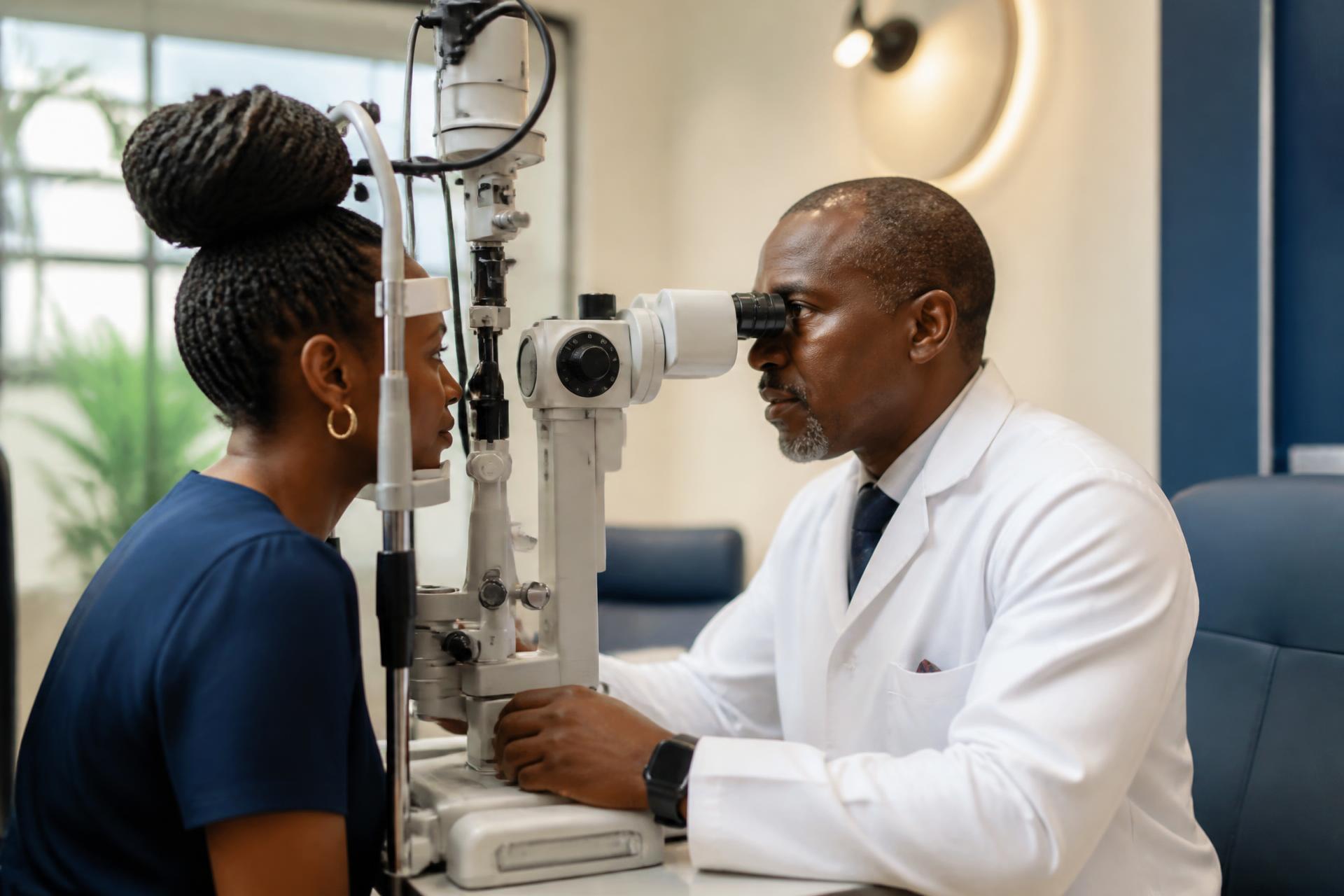
A glaucoma assessment is painless and usually completed in one visit. It includes vision and refraction, measurement of eye pressure, examination of the front of the eye at the slit lamp, examination of the optic nerve, and where indicated a visual field test, optic nerve OCT scan and gonioscopy to look at the drainage angle.
At Standard Eye Specialist Hospital these investigations are carried out in house, including applanation tonometry, visual field analysis, OCT and digital fundus imaging.
Frequently asked questions
- Can glaucoma be cured?
- No. Glaucoma is controlled rather than cured. Treatment lowers eye pressure to reduce the risk of further optic nerve damage, and most people keep useful vision when it is found early and treated consistently.
- Will I definitely go blind?
- Most people who are diagnosed and treated do not go blind. Risk rises when glaucoma is found late or when treatment and reviews are not kept up.
- How often should I be reviewed?
- This depends on how advanced the condition is and how well pressure is controlled. Your ophthalmologist will set an interval, often between one and six months at first, then longer once you are stable.
Would you like a glaucoma assessment?
Request a specialist assessment at our hospital in Garki, Abuja.
You can also read about our glaucoma clinic and treatments at Standard Eye Specialist Hospital.
Answers in this topic
Common glaucoma questions
Choose the question closest to yours.
What is glaucoma?
Glaucoma is a group of conditions in which the optic nerve, the cable joining the eye to the brain, is progressively damaged.
Read the answerWhat are the symptoms of glaucoma?
The common form of glaucoma usually causes no symptoms at all until a significant part of the side vision has gone.
Read the answerWhat are the early signs of glaucoma?
The earliest signs of glaucoma are clinical rather than felt.
Read the answerWhat does glaucoma screening involve?
Glaucoma screening is a painless examination that checks vision, eye pressure, the front of the eye, the drainage angle and the optic nerve, with a visual field test and optic nerve OCT scan where indicated.
Read the answerIf a parent has glaucoma, what is my risk?
Having a parent, brother or sister with glaucoma raises your risk several times over compared with someone with no family history, and the risk is higher still for people of African ancestry.
Read the answerWhat is eye pressure, and what is a normal reading?
Eye pressure, or intraocular pressure, is the pressure of fluid inside the eye, measured in millimetres of mercury.
Read the answerWhich tests are used to diagnose glaucoma?
No single test diagnoses glaucoma.
Read the answerWhat is a visual field test like?
A visual field test maps how sensitive your vision is across the whole field of view.
Read the answerWhat is gonioscopy and why is it done?
Gonioscopy is an examination of the drainage angle, where fluid leaves the eye.
Read the answerWhat does an OCT scan show in glaucoma?
OCT, or optical coherence tomography, takes a cross sectional scan of the retina and optic nerve using light, with no contact and no radiation.
Read the answerHow do glaucoma eye drops work?
Glaucoma eye drops lower pressure inside the eye either by improving the outflow of fluid or by reducing how much fluid the eye makes.
Read the answerWhat laser treatments are used for glaucoma?
The laser treatments used for glaucoma at Standard Eye are diode laser cyclophotocoagulation and thermal cyclophotocoagulation.
Read the answerWhen is glaucoma surgery needed?
Glaucoma surgery is considered when eye pressure stays too high despite drops and laser, when the optic nerve continues to be damaged, when advanced disease needs a much lower pressure, or when drops cannot be tolerated or used reliably.
Read the answerWhat is a trabeculectomy?
A trabeculectomy is glaucoma surgery that creates a small controlled channel through the wall of the eye, allowing fluid to drain into a reservoir under the thin surface membrane.
Read the answerWhat is a glaucoma drainage device?
A glaucoma drainage device, sometimes called a tube or shunt, is a small implant that carries fluid from inside the eye to a plate placed on the outer wall of the eye, where the fluid is absorbed.
Read the answerWhat is MIGS, or minimally invasive glaucoma surgery?
MIGS stands for minimally invasive glaucoma surgery, a group of procedures that improve the eye's own drainage through very small incisions, often at the same time as cataract surgery.
Read the answer